
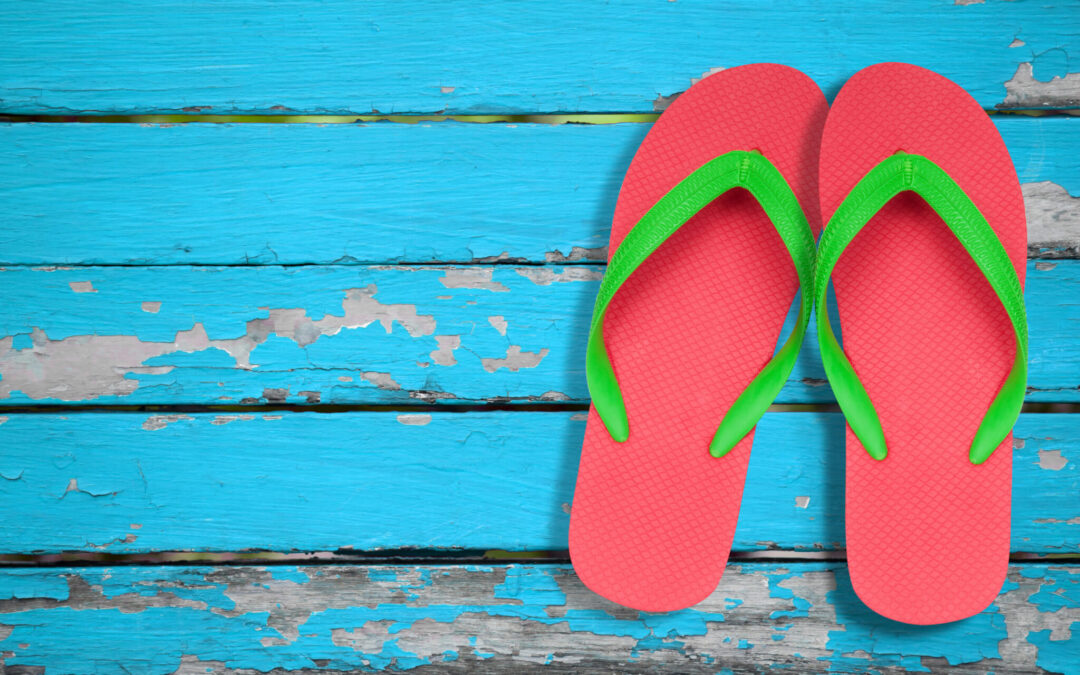
History of National Flip Flop Day
National Flip Flop Day was founded by Tropical Smoothie Cafe in 2007 with the intention of encouraging everyone to get into the spirit of summer by breaking out their favorite pair of flip flops after a long winter.
National Flip Flop Day was originally scheduled to occur on the third Friday in June. In 2023 the date was changed to the Wednesday after Memorial Day, to coincide with the arrival of summer and warmer weather.
Customers who visit a participating Cafe on Flip-Flop Day wearing – you guessed it, flip-flops – have the option to receive a free smoothie.
But there’s more exciting news! Not only does Tropical Smoothie Cafe give its customers a free drink and the chance to air their feet, it also uses National Flip-Flop Day as an opportunity to raise money for Camp Sunshine – a camp that offers respite and support to children with life-threatening illnesses and their families.
In fact, in the years since this day began, more than eight million dollars has been raised in support of this charitable organization!
Of course, people have been wearing flip-flops and other styles of simple sandals for thousands of years, with the earliest wearers being the Ancient Egyptians in 4000 BC.
Since then, this type of sandal has been worn throughout the world and has become a favorite for people enjoying a relaxing day at the beach or walking around in the sunshine.
Facts About National Flip Flop Day
Ancient Sandals Resembled Modern Flip Flops
Archaeologists have found thong-style sandals dating back thousands of years, including papyrus and palm-leaf examples from ancient Egypt and wooden or straw “zori” in Japan.
These early designs already used a toe post and flat sole similar to modern flip flops, showing that the basic concept of a simple sandal secured between the toes has changed very little over millennia.
How Japanese Zori Helped Popularize Flip Flops in the West
The widespread popularity of flip flops in the United States is often traced to Japanese “zori” brought back by American soldiers after World War II.
These lightweight, thong-style sandals, originally made from rice straw or fabric, inspired mass-produced rubber versions that became beachwear staples in the 1950s and 1960s.
Why New Zealanders Call Them “Jandals”
In New Zealand, flip flops are commonly known as “jandals,” a name that originated as a trademarked term in the 1950s.
The word is a contraction of “Japanese sandals,” reflecting both the influence of Japanese zori on their design and the country’s effort to develop a local rubber sandal industry after World War II.
Flip Flops Can Subtly Change the Way People Walk
Biomechanical studies have found that wearing flip flops alters gait compared with athletic shoes.
Research from Auburn University showed that flip flop wearers tend to take shorter strides and curl their toes to grip the sole, changes that can increase strain on the ankles and lower legs and may contribute to overuse injuries if worn for long periods.
Link Between Flip Flops and Foot Pain Conditions
Podiatric research suggests that thin, unsupportive flip flops can aggravate conditions such as plantar fasciitis and flat feet.
Because many flip flops lack arch support and cushioning, the plantar fascia absorbs more impact with each step, which can lead to heel pain, arch pain, and fatigue, especially on hard surfaces.
Flip Flops Are a Surprisingly Common Source of Injuries in Children
A study of pediatric foot and ankle injuries found that flip flops contributed to a significant number of emergency visits, often due to tripping, stubbed toes, and falls.
Open toes and loose straps provide little protection or stability, which is why many pediatric specialists recommend sturdier sandals or closed shoes for playgrounds and sports.
Discarded Flip Flops Are a Major Marine Litter Problem
Billions of cheap foam flip flops are produced each year, and many end up as plastic debris on beaches and in the ocean.
Surveys of shorelines in East Africa and Asia regularly rank flip flops among the most common footwear items found, prompting projects in countries like Kenya to collect and upcycle washed-up sandals into art pieces and household products.